I was fortunate enough to find a copy of this at my city library, it truly is a treasure. I've listened to it three times completely through since obtaining it four days ago. I've always been into stuff by Abrams or other artists involved with the AACM, but I haven't been able to get me hands dirty in a lot of recordings. This particular album contains eclectic cuts with styles ranging from abstracted blues, free-form improvisation and even hard bop.October 22, 2008
"Things To Come From Those Now Gone" - Muhal Richard Abrams
I was fortunate enough to find a copy of this at my city library, it truly is a treasure. I've listened to it three times completely through since obtaining it four days ago. I've always been into stuff by Abrams or other artists involved with the AACM, but I haven't been able to get me hands dirty in a lot of recordings. This particular album contains eclectic cuts with styles ranging from abstracted blues, free-form improvisation and even hard bop.October 10, 2008
"Let Freedom Ring" - Jackie McLean

Jackie McLean's 1960s Blue Note albums are never fail high energy performances and well entertaining. I remember reading in Blue Note Records: The Biography that he struggled and was self-critical during his mid hard bop period with finding a comfortable sound. It wasn't until Ornette Coleman was on the scene allowing McLean to develop his style. In this LP, and others like Destination Out! (1963) and New and Old Gospel (1968, which features Coleman solely on trumpet), you can really here the influence in his horn. The band is swinging, especially Billy Higgins on drums. There's the classic hard bop sound, but McLean's playing dips further into uncharted territory with squeaks, grunts, and more free playing than his other hard bop contemporaries.
September 5, 2008
"Tijuana Moods" - Charles Mingus

This is a near flawless performance in my opinion. I love the whimsicality of Mingus' compositions, and how the band alters the tempos constantly during tracks displaying how tight these guys were. Mingus is praised for joining highly arranged parts mixed with sections where it sounds like the band is falling down stairs. In this 1957 (released in 1962) session we can hear early demonstrations of this concept, and even though you don't immediately think of Mingus when you hear the term "free jazz," he certainly was an influence and opened a lot of doors for the avant-garde.
August 21, 2008
"Yasmina, A Black Woman" - Archie Shepp

Sorry my posts are so few and between, it's been a crazy summer. I'm still managing one post a month which will have to do for now.
July 14, 2008
"Marion Brown Quartet" - Marion Brown

Nabbed a copy of this on vinyl a few weeks back; don't get too excited, it's just a 2002 Get Back reissue, but none the less, very cool to have coming off the needle.
May 22, 2008
"Pharoah's First" - Pharoah Sanders

I think these recordings were created during an interesting transition in jazz, and it's definitely heard well in this session. By the mid 60s, Hard Bop was reaching it's peak and the Avant-Garde has been making a firm plant in jazz. With the exception of Stan Foster's playing, the Quintet's rhythm section showcases straight ahead, bop. The affects of Coltrane's playing is certainly heard through Sanders' licks, melodies, and improvising. It's interesting to hear how his progressive sense challenges the rest of the band, and Foster keeps up at times. This album is a must have.
1965 - ESP Disk'.
April 11, 2008
"Slug's Saloon" - Albert Ayler
This is a beautiful set put on by Ayler's band. Often times I prefer his live recordings over his studio sessions because I think the lower produced quality add to the expressiveness of the music, but also because you can really hear more of what Ayler is feeling and how hard he and his band is playing.Everyone plays here like it may be their last date. Michel Sampson's violin playing is out of this world and creates a wonderful relationship behind Albert's squeling. Ron Jackson frails on the drums giving you an artilary of rhythm and Albert's brother Donald plays like he is going to take off. With many reminders of the themes, the ensemble parts are nearly dead perfect, creating a balance between harmony and free improvising.
My favorite tune is Our Prayer, which Ayler incorporates marching band melodies (which I'm sure he got from his time in the military). He creates wonderful build-ups that are destroyed by controlled-chaotic (if that makes any sense), collective, free expressions. The album also features token composition like Bells, Ghosts, and Truth Is Marching In.
In the documentary, My Name Is Albert Ayler, drummer Sunny Murray stated that Albert "played with love," and that couldn't be more apparent than in these cuts.
1966 - ESP Disk.
Albert Ayler - Tenor Saxophone; Donald Ayler - Trumpet; Ron Jackson - Percussion; Lewis Worrell - Bass; Michael Sampson - Violin.
March 20, 2008
Ornette Coleman Quartet Reunion
March 4, 2008
Music Millennium Picks
February 18, 2008
"Broken Shadows" - Ornette Coleman

Coleman produces some great sets with his brief columbia sessions. Science Fiction, has more of a space-y and electronic aesthetic, where as Broken Shadows is more reminiscent of the Atlantic recordings but perhaps a bit more aggressive.
Besides the aggressiveness, you get all the boogie and swinging and positivity you’d expect. Tracks like “School Work” leave dancing melodies in your head (he has used this melody numerous of times in other compositions). Don Cherry plays at such a great level on these recordings and complements Ornette so well as he always does. Also accompanied is Bobby Bradford which makes an interesting variation to Cherry, and we also hear a strong tone difference of Dewey Redman against Coleman. Higgins and Blackwell are shown playing together making heavy rhythms and flooding sheets of percussion.
The last two tracks have Webster Armstrong joining the group singing some blues. The exciting juxtaposition of the harmolodics and vocals is like a wonderful roller-coaster filled with expression, feeling, and soul.
1972 - Columbia.
Ornette Coleman - Alto Sax; Don Cherry - Pocket Trumpet; Dewey Redman - Tenor Sax; Bobby Bradford - Trumpet,Charlie Haden - Bass, Billy Higgins - Drums, Ed Blackwell - Drums; Jim Hall - Guitar, Cedar Walton - Piano,Webster Armstrong - Vocals.
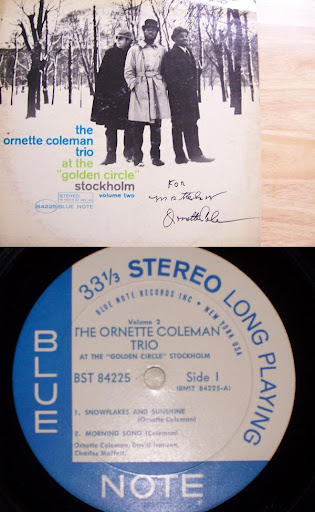
In spirit of Ornette, I’d like to talk about the PDX Jazz Festival. Not only did I get to see him perform, I saw a conversation with him and his son Denardo hosted by Howard Mandel (author Miles, Ornette, and Cecil: Jazz Beyond Jazz); at which I was able to shake Ornette’s hand and have him sign my Blue Note LP. “Only Thinking about improving the idea,” was the very first comment by him. And he continued to express his thoughts about sound, life, knowledge, sex... Everything! Always remaining in the most positive attitude and keeping a smile on his face.
Now from my understanding, all of the educational programs hosted by the festival were recorded and will eventually be available through KMHD. This one is worth checking out.
Later that night (to top off one of the best days in my life), I went and saw Coleman at the Schnitzer. Man, it was unbelievable. It was so transcendental and sublime, I spent most of the show with my eyes closed tapping my feet. Throughout the performance, melodies from classic compositions were mixed in. Like, “School Work”, “Beauty Is a Rare Thing”, “Lonely Woman”, “Turnabout”, and “Morning Song”. I feel privileged seeing how it has been 25 years since the last time Coleman played in Portland and perhaps one of the last.