Jazz Blogs - BlogCatalog Blog Directory

February 18, 2008

"Broken Shadows" - Ornette Coleman


Coleman produces some great sets with his brief columbia sessions. Science Fiction, has more of a space-y and electronic aesthetic, where as Broken Shadows is more reminiscent of the Atlantic recordings but perhaps a bit more aggressive.

Besides the aggressiveness, you get all the boogie and swinging and positivity you’d expect. Tracks like “School Work” leave dancing melodies in your head (he has used this melody numerous of times in other compositions). Don Cherry plays at such a great level on these recordings and complements Ornette so well as he always does. Also accompanied is Bobby Bradford which makes an interesting variation to Cherry, and we also hear a strong tone difference of Dewey Redman against Coleman. Higgins and Blackwell are shown playing together making heavy rhythms and flooding sheets of percussion.

The last two tracks have Webster Armstrong joining the group singing some blues. The exciting juxtaposition of the harmolodics and vocals is like a wonderful roller-coaster filled with expression, feeling, and soul.

1972 - Columbia.

Ornette Coleman - Alto Sax; Don Cherry - Pocket Trumpet; Dewey Redman - Tenor Sax; Bobby Bradford - Trumpet,Charlie Haden - Bass, Billy Higgins - Drums, Ed Blackwell - Drums; Jim Hall - Guitar, Cedar Walton - Piano,Webster Armstrong - Vocals.

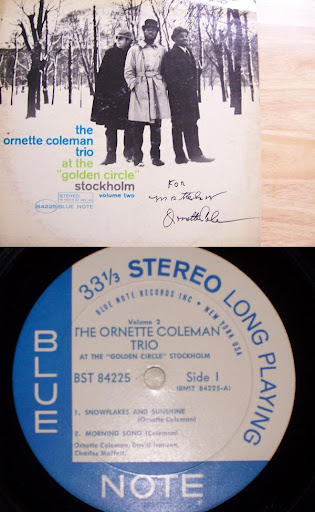
In spirit of Ornette, I’d like to talk about the PDX Jazz Festival. Not only did I get to see him perform, I saw a conversation with him and his son Denardo hosted by Howard Mandel (author Miles, Ornette, and Cecil: Jazz Beyond Jazz); at which I was able to shake Ornette’s hand and have him sign my Blue Note LP. “Only Thinking about improving the idea,” was the very first comment by him. And he continued to express his thoughts about sound, life, knowledge, sex... Everything! Always remaining in the most positive attitude and keeping a smile on his face.

Now from my understanding, all of the educational programs hosted by the festival were recorded and will eventually be available through KMHD. This one is worth checking out.

Later that night (to top off one of the best days in my life), I went and saw Coleman at the Schnitzer. Man, it was unbelievable. It was so transcendental and sublime, I spent most of the show with my eyes closed tapping my feet. Throughout the performance, melodies from classic compositions were mixed in. Like, “School Work”, “Beauty Is a Rare Thing”, “Lonely Woman”, “Turnabout”, and “Morning Song”. I feel privileged seeing how it has been 25 years since the last time Coleman played in Portland and perhaps one of the last.
February 10, 2008

"Reflections" - Steve Lacy


I think this is one of the finest, individualistic interpretations of Thelonious Monk tunes that I have heard.  You can tell Lacy really understood how to translate his melodies and work them with just the right amount of dissonance and tension; and when and when not to apply it.  The rhythm company performs top notch and Mal Waldron seems to fit in well with Neidlinger and can anyone honestly think of any time when they didn't enjoy hearing Elvin Jones.  

My favorite is "Hornin' In."  Waldron starts off with this vamping and then after the first bar or so Lacy steps in with his wonderfully pitched horn.  The way he plays his solos it seems like many horn players were trying to mimic five years later.  Waldron's phrasing seems spot on and the harmonies between him and Lacy are out of this world.

This is an album I could consistently listen to for the rest of my life.     
1958 - Contemporary.

Steve Lacy - Sax (Soprano); Mal Waldron - Piano; Buell Neidlinger - Bass; Elvin Jones - Drums.

February 1, 2008

"Out To Lunch" - Eric Dolphy


Out to lunch is a beautiful album.  Whenever I hear Dolphy I truly understand the ideas in his head and the dialect he's trying to make with his horn.  Anyway, this album cooks.  Everyone plays at such a high level, it's no wonder why so many refer to the album as the best of the era, the best Blue Note, the best of the avant-garde, or even some say one of the best jazz albums period.  The cuts have these whimsical aspects to them, but enough emotions and definitely the blues remains so that anything meaningful still exists.  Tony Williams, I think, is only 18 years old here, and he has already shown his prominence as a common drummer on many Blue Note dates and many to follow.  

It seems every time Dolphy plays, it's the last chance he'll ever have to play.  You can really here his passion in his recordings, and it's amazing how many ideas you can hear come out of one solo by him; and they're all so coherent and just right on.  Richard Davis responds well and also is excellent at guiding Dolphy, and Williams always knows what to hit and what to omit every time.  

I'll leave you with a link to this wonderful article by Milo Miles.
1964 - Blue Note.

Freddie Hubbard - Trumpet; Eric Dolphy - Sax (Alto), Flute, Bass Clarinet; Bobby Hutcherson - Vibes; Richard Davis - Bass; Anthony Williams - Drums.

January 27, 2008

"Symphony For Improvisers" - Don Cherry


This is a great performance lead by Cherry.  You get two different dimensions of sax coming from the jagged sounds of Pharoah Sanders and the more straining sounds of Gato Barbieri.  And when Sanders plays his piccolo, it really makes an interested contrast to Cherry's horn playing.  The best is when the musicians sort of sync up for those brief sublime moments, and the listener is unsure if they are just playing an arranged part, or if their ears are just adjusting to the actions of the musicians.  I love Karl Berger's vibe playing as well, and the way he follows Don Cherry's playing adds a nice effect.  Around 9:30 into the album title tracked, the group plays an ensemble part that is just breathtaking and is than followed by a swinging solo by Blackwell.  "Manhattan Cry" starts off almost like a ballad, but steadily evolves into a freeing collective of sounds that sticks with the album's theme.
1966 - Blue Note.

Don Cherry - Cornet, Trumpet; Ed Blackwell - Drums; Gato Barbieri - Sax (Tenor); Henry Grimes - Bass; Jean-François Jenny-Clark - Bass; Karl Berger - Piano, Vibraphone; Pharoah Sanders - Piccolo, Sax (Tenor).

January 23, 2008

"My Name Is Albert Ayler"


For the last year, Albert Ayler has been very important and influential to me. I was super excited to see My Name Is Albert Ayler, a film by Kasper Colling that the NW Film Center showed as part of their Reel Music Festival.

It mainly follows his brother, Donald, and his father, Edward. The filmmaker also travels abroad and interviews friends and old girlfriends from when Ayler spent time in northern Europe. This showed different opinions and perspectives offering unique ways of understanding Ayler as a person, but also show how he influenced everyone on different levels. Some of the best parts are interviews and phone conversations with the drummer Sunny Murray. He, very charismatically, shared stories of Albert and Donald. Murray talked about the tonal quality of Aylers playing with how he could expand on one note and get so much out of it. "Albert played it with love," is how Sunny referred to Albert playing his horn.

I was surprised that the story didn't focus on so much of the religious or spiritual concepts of Albert, but instead focused on his relationship with his brother and Maria Parks. They continue with how Albert began to be isolated, whether he was causing it or Parks, and how his brother was pushed out of the band, and leading to Donald's nervous breakdown and ultimately ending with Albert's death in 1970.

The Third aspect of the film was taken from audio interviews with Albert, and you hear his own voice, hauntingly over footage, music, and photographs. It leaves you with wonderful insight into his concepts and ideas. My favorite was when he was talking about playing at Coltrane's funeral and he said, "How could I do that, how could I play crying."

2005, Directed by Kasper Collin

January 18, 2008

"Ornette: Made In America" - Ornette Coleman


Wednesday night, as part of the Reel Music Fest, Ornette: Made In America was shown at the Portland Art Museum. I have seen clips of this film on youtube, and as I had a prior glimpse of its production style, I still didn't know what to expect. The film started in 1983 in Ft. Worth, Texas where a ceremony is being held to make an official Ornette Coleman Holiday in the city, where Coleman was also handed the key of the city.

The film furthered with various interactions of Ornette with his son, old friends from Ft. Worth, colleagues and musicians. We saw him telling stories of his past, and montages of him performing live at clubs and events. With sort of a Warhol-esq editing style, it definitely had its psychedelic moments.

My favorite part was when there was clips from 1968 where Coleman was jamming w/ his son (age 12 at the time) and Charlie Haden. From the editing, I couldn't tell if the music was directly taken from the footage, and I can't help to wonder if it was from the Blue Note session for "The Empty Foxhole." Since the CD is out of print, I have been holding out for a Liberty pressing of this on vinyl, so I haven't heard these recordings. There was one segment where young Denardo was playing single rhythmic snare hits, while Haden was walking high on the bass' neck, and Ornette was playing so melodically with such beautiful lyricism. Then, completely randomly, Denardo would unleash these chaotic blast beats, but only for a few moments before returning to his single snare. This is great foreshadowing for me for these recordings.

The movie was really fun, I loved learning about Colemans concepts about his music. For example, him comparing Religions on an emotional level and his music on a creative level and how that intertwines, or the idea of intuitive intelligence as a third world technology.
1985, Directed by Shirley Clark

January 14, 2008

"Coltrane Time" - John Coltrane/"Hard Driving Jazz" - Cecil Taylor

There's a lot of diverse opinions about this recording session, and whether we hate or love it or don't get it, I think all fans of Coltrane and Taylor wonder, how would these two amazing individuals sounded together in 1965 or 1966?  This
 was originally recorded with Cecil Taylor as the leader.  It was
 produced by Tom Wilson, and being under pressure to appease the label heads, he pulled this line up together.  Five years after it was recored, it was issued with the title "Coltrane Time."  We have to remember that Taylor has already recorded "Jazz Advance" on Blue Note two years earlier where we could hear him already
 experimenting with the physicality of his music and the sporadic dissonance in his chords. But in this date 
he is put with more of a front line, and even though Coltrane was
 beginning to broaden his playing, he appears a little premature to be playing with Taylor, and ex-messenger Kenny Dorham seems way out of place.  

To sum it up, I think you get mainly two opinions about this record.  One is from new
 fans of Coltrane who are just diving in and lose grasp of Taylors concepts.  The other is fans of both Coltrane and Taylor and the "new sound" but understand that these artist just weren't
 meant to be.  I for one, am just gald that this recording was made possible and is available.  It's certainly worth the listen.
1958, United Artists/Blue Note-EMI.
J.Coltrane - TS, K.Dorham - Tr, C.Taylor - P, C.Israels - B, L.Hayes - Dr

January 9, 2008

"Components" - Bobby Hutcherson

My main love for Bobby Hutcherson is his ability to successfully and convincingly cross over to many styles of jazz.  Whether it's the "new sounds" playing with Archie Shepp in Newport, or Eric Dolphy's "Out To Lunch," or cookin' on the soul jazz sessions of Big John Patton, or his post bop dates with Andrew Hill or McCoy Tyner, he plays strong all around.  "Components" takes us into the popular post bop sounds of the mid 60s.  Undoubtedly, Hancock and Carter are comfortable setting a rhythm platform and Joe Chambers swings on the drums.  I particullarly love "Little B's Poem" and "West 22nd Street Theme."  Some how in my head, these melodies automatically create images of urban New York during this period. You then have cuts like "Movement," which turns into a free form improvising setting, reminding us how universal Hutcherson is.
1965, Blue Note.

B.Hutcherson - Marimba, Vibraphone; F.Hubbard - Trumpet; H.Hancock - Organ, Piano; J.Spaulding - Flute, Sax (Alto); J.Chambers - Drums; R.Carter - Bass

January 8, 2008

25th Reel Music Film Festival


Lots of great viewings this year from the NW Film Center. I'm going to try and see as many as I can this month. Also, just to note that there's a documentary on the closing of Music Millennium NW. As I am an ex-staff member from that store, and saw all the unfolding happen there, this film should hit exceptionally close to home.
Ornette: Made In America
My Name Is Albert Ayler
Imagine the Sound

Knowing All of You Like I Do

The Real Godfathers of Punk


This article, by Jason Gross, is very relevant to how we consider free jazz and it's relationship with rock and punk rock of the 70s and 80s.
The Real Godfathers of Punk